Editorial policy
Who writes here, how claims are established, how the site is funded, what we refuse to publish, and how to get an error fixed.
Last updated . Publisher: ASSURITY s.r.o.
Who writes here
pravia.online is published by ASSURITY s.r.o. The director of publication and responsible editor is Jennifer Bell, who writes or edits everything published on the site and is accountable for it. Every article carries a named byline and a publication date. There are no anonymous or pseudonymous articles.
We do not publish guest posts, sponsored articles, or content supplied by advertisers or by public relations agencies. If that ever changes, such content will be labelled unmistakably as advertising and will not carry an editorial byline.
How we establish a claim
The order of preference for sourcing a factual statement is:
- The vendor’s own current documentation for what a product does, which platforms it supports and what a plan contains.
- Independent testing organisations — AV-TEST and AV-Comparatives — for detection and performance figures. We cite the laboratory, not a secondary report of it.
- Primary platform documentation from Microsoft, Apple or Google for statements about what an operating system does or permits.
- Named public bodies such as ENISA for threat-landscape context.
Sources are listed at the foot of substantive articles, with links, so that you can check them rather than take our word for it. Links to sources are never affiliate links and we say so on the page.
What we do when we cannot verify something
We say so, in the article, in plain words. We do not fill a gap with a plausible-sounding number.
Three rules follow from that, and they are not negotiable:
- No invented statistics. If we cannot point at the source of a figure, the figure does not appear. Where widely quoted figures are not comparable with one another, we say that instead of picking the most dramatic one.
- No unsourced detection rates. If a product has no current entry in a recognised independent test, we tell you that no independent figure exists rather than substituting an impression.
- Attribution for vendor claims. Statements a vendor makes about itself — a no-logs policy, an audit, a guarantee — are reported as the vendor’s claim, with a pointer to the vendor’s own wording, not restated as established fact.
We also publish prices only by linking to the live vendor page. A price typed into an article goes stale within weeks, and a stale price is a misleading price.
How this site is funded
Entirely by affiliate commission. There is no subscription, no paywall, no display advertising network, and no sponsored content.
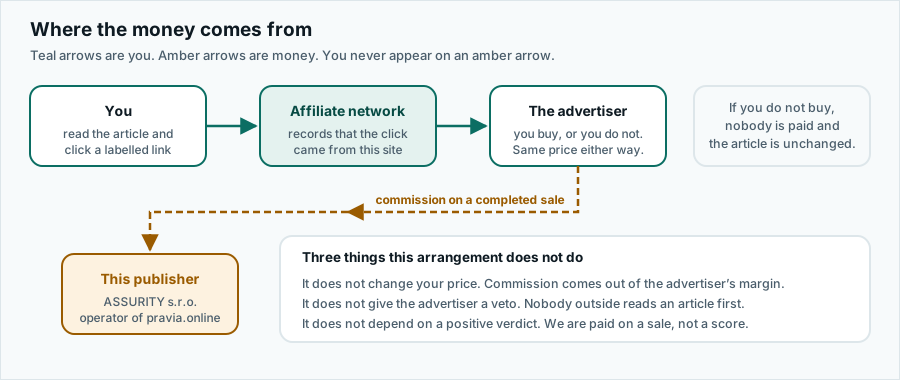
Three specific things follow, and we commit to all three:
- You pay the same price. Following a partner link never costs you more than going to the vendor directly. Commission comes out of the advertiser’s margin.
- We are paid on a sale, not on a verdict. No commission is contingent on a positive review, a score, or a ranking position.
- A negative article stays up. If the honest conclusion is that a reader should not buy the product, or should use the free tool that comes with their operating system, we publish that. There are such passages in our current articles.
Advertiser independence
No advertiser, affiliate network or agency:
- Sees an article before it is published.
- Approves, reviews or signs off editorial copy.
- Has any right to have content amended or removed, except where it is factually wrong — in which case the correction happens because it is wrong, and it happens for anyone who reports it, advertiser or reader.
- Can buy a ranking, a score, a placement or a favourable conclusion.
- Is given a right of reply that readers do not have.
We name the drawbacks of products we earn money from. That is the whole test of whether a policy like this is real, and it is the one we would ask you to apply to us.
What we will not do
Explicitly and permanently, this site does not publish:
- Fake testimonials. No invented reader stories, no fabricated quotes, no “reader-submitted” framing for copy we wrote ourselves. An earlier version of this site used exactly that framing. It has been removed.
- Invented ratings. No made-up star ratings, no scores out of ten derived from nothing, no “editor’s choice” badge awarded to whichever advertiser pays most. We publish no numerical scores at all.
- User reviews we cannot verify. There is no review widget on this site and there never will be one; we have no way to establish that a submitted review is genuine, and an unverifiable review is worse than none.
- Artificial urgency. No countdown timers, no “only 3 left”, no “offer ends at midnight” unless a vendor has published a genuine end date, and no manufactured scarcity of any kind. Manufactured time pressure exists to stop a reader thinking, which is the opposite of what this site is for.
- Guaranteed-result claims. No product stops all malware, guarantees you will not be hacked, or makes you anonymous. We do not write those sentences and we flag them when vendors do.
- Fear as a sales technique. We describe risks proportionately and we name the free measures that address them, including where those measures make a purchase unnecessary.
- Fake scarcity of expertise. No invented credentials, no fictional test laboratory, no claim to have benchmarked something we did not benchmark.
- Comparison tables engineered to produce one winner. A checklist written so that the advertised product passes every line is an advertisement, not a comparison.
How advertising is labelled
Every commercial link on this site carries all of the following, without exception:
- A disclosure bar at the very top of every page, above everything else.
- A disclosure box immediately after the headline, before any promotional content appears.
- A visible “Partner link” label on the button itself — including buttons in sidebars.
- A note directly beneath each button stating that we earn a commission and that it costs the reader nothing extra.
- The
rel="sponsored nofollow noopener"attribute in the markup, so that search engines are told the link is paid. - An “Advertisement” label on each promotional block.
If you find a commercial link on this site that is missing any of these, that is a defect. Please tell us and we will fix it.
Corrections procedure
We would rather be corrected than be wrong quietly. Anyone may report an error — reader, advertiser, competitor or subject.
- Tell us. Email info@pravia.online with the page address, the passage concerned and, if you have one, the source that shows it is wrong. A correction request is never refused for being informally worded.
- We acknowledge it, normally within five working days.
- We check it against a primary source — the vendor’s own documentation, a testing laboratory, or platform documentation — rather than against another article.
- We fix it. A factual error is corrected as soon as it is confirmed. We do not wait for a scheduled update and we do not quietly delete the page.
- We say what changed. A substantive correction — anything that alters the meaning, a figure, a specification, or the conclusion — is disclosed on the page itself, and the modification date is updated. We do not rewrite history. Our main article carries a list of the claims we corrected, including one that was materially wrong about platform support.
- Typographical fixes that do not change meaning are made without a note.
If we conclude that the reported passage is correct as published, we will say so and explain the source we relied on.
Complaints
Complaints about editorial content, about the labelling of advertising on this site, or about the conduct of the publisher should be addressed to Jennifer Bell at info@pravia.online, or in writing to ASSURITY s.r.o., Na Folimance 2155/15, Vinohrady, 120 00 Praha 2, Czech Republic.
If a complaint concerns personal data, the privacy policy sets out your rights and the supervisory authority you may complain to. If it concerns consumer protection, the Czech Trade Inspection Authority is named in our legal notice.